
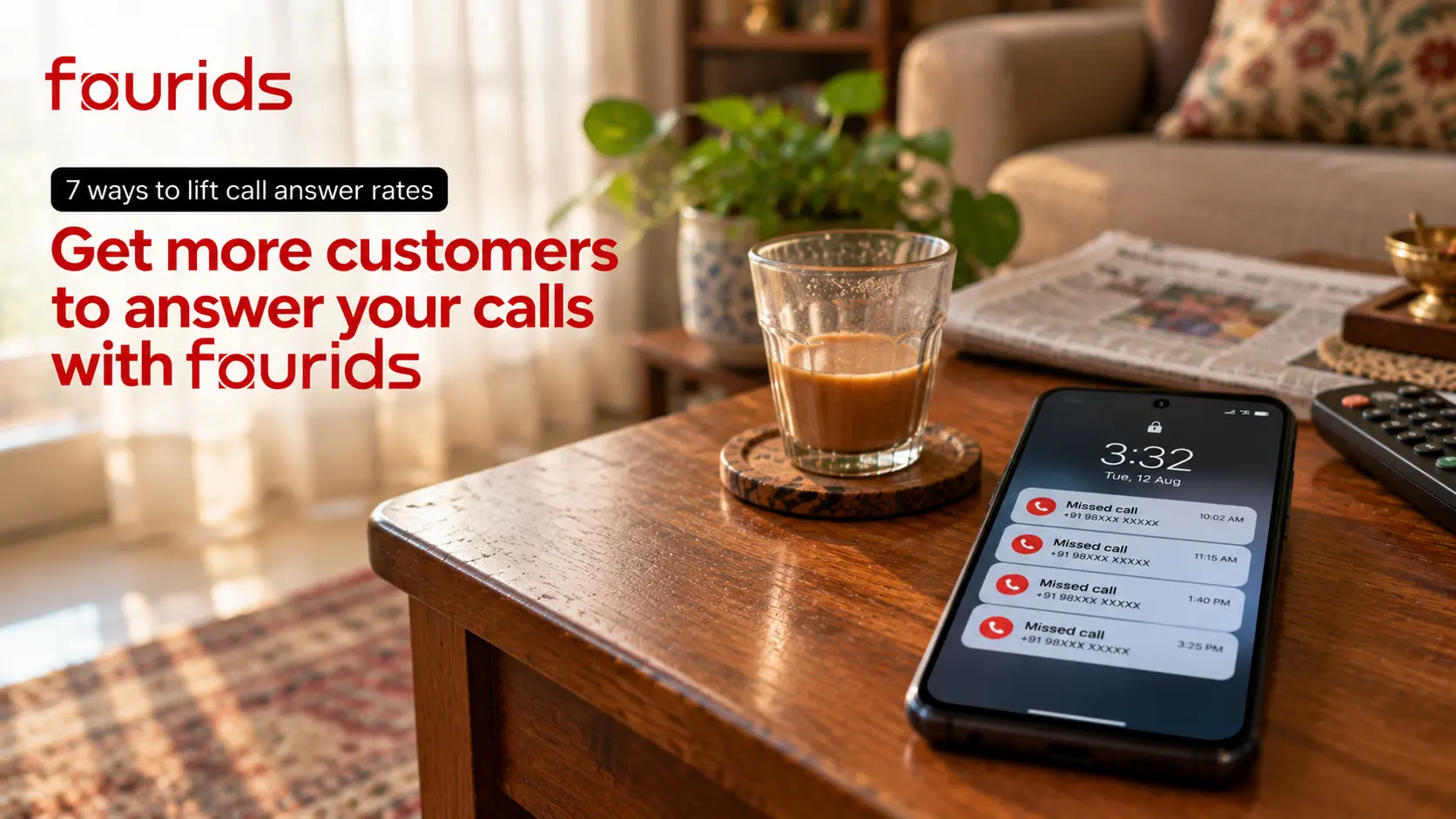
Ask any collections head or sales manager what keeps them up at night and you’ll hear some version of the same answer.
Not the script. Not the offer. The fact that nobody picks up.
Indian customers have become very good at ignoring phone calls. Years of loan offers, fake KYC calls and “courier held at customs” scams have taught them to treat every unknown number as a risk. Genuine businesses pay the price.
The good news: answer rates aren’t pure luck. Most of what decides whether your call gets picked up is in your control, long before the phone rings.
In short: Indian businesses can improve call answer rates by protecting the reputation of their numbers, fixing spam labels instead of switching numbers, following TRAI and consent rules, using the right number series, showing a verified business name through branded calling, verifying every number and vendor that calls on their behalf, and tracking answer rates, complaints and spam labels so problems are caught early.
1. Why does a number’s reputation decide whether calls are answered?
Because operators and caller ID apps judge your number before your customer does.
Operators and caller ID apps quietly keep notes on each number: the volume it dials, the length of its calls, and how often people block or report it. Operators now read these signals at enormous scale, and Airtel’s system on its own has marked more than 98 billion calls as suspected spam. Not all of them came from fraudsters. Some were genuine businesses whose dialling simply looked suspicious.
It works a bit like a seller rating on a shopping app. A run of bad reviews and people scroll straight past, and the rating doesn’t fix itself.
Start by listing every number your business calls from, then check how each one shows up on customers’ phones today.
2. Should you change numbers when they get marked as spam?
Usually not. It feels like a fix, but it rarely is.
Swapping in a new number feels like a clean start. In practice, an unknown number suddenly making hundreds of calls is exactly what spam filters are tuned to catch, so it tends to end up with the same label as the one it replaced. Worse, customers who had saved your old number now get a call from someone they don’t recognise.
The lasting fix is to clean up the numbers you already have. That means finding out which ones carry spam labels, asking the operators and apps involved to review them, and changing the calling habits that caused the problem.
3. What calling practices keep business numbers out of trouble?
Mostly the ones TRAI already expects. Good compliance and good answer rates tend to go together.
Before you dial:
- Scrub your lists against the national Do Not Disturb register and respect each customer’s sector-wise preferences.
- Make sure you have consent to call, and records to prove it. India’s Digital Personal Data Protection Act, 2023 makes this more important, not less.
- Register as required on the DLT platform before running promotional calls.
While you dial:
- Keep service calls and promotional calls on separate numbers.
- Call at reasonable hours and don’t keep redialling someone who hasn’t picked up.
- Watch complaint levels closely. Under TRAI’s 2025 amendments to the spam regulations, action can follow after five complaints in ten days, and repeat offences can lead to every line being disconnected.
4. Are you calling from the right number series?
In India, the number itself now tells the network what kind of call it is.
Banks, NBFCs, insurers and other regulated financial institutions must use 1600 numbers for service and transactional calls. Courier, logistics and utility companies are being moved onto the new 1601 series. Promotional calls belong on 140 numbers.
Getting this right has a clear benefit. TRAI has made it plain that 1600 calls are not to be labelled or filtered as spam.
Even so, a correct prefix doesn’t make people pick up. Truecaller’s data, covered by TechCrunch, points to roughly four in five of these calls going unanswered. Customers remember brand names, not number ranges.
5. How does branded calling improve answer rates?
Because people decide in a second or two, and a familiar name settles the doubt that a bare number creates.
With branded calling, the incoming call carries your approved company name instead of “+91 98XXX XXXXX”. Nothing needs installing on the customer’s phone. They see who it is, and the decision becomes an easy one.
You don’t have to brand every line on day one. Start where an unanswered call costs you most:
- Fraud alerts and KYC calls
- Collections and EMI reminders
- Delivery and appointment confirmations
- Customer support callbacks
| Without branding | With branding | |
|---|---|---|
| On the screen | A ten-digit number | Your business name, verified |
| Customer’s first thought | “Is this another scam?” | “Oh, it’s my bank / courier / clinic” |
| Likely outcome | Rejected or left to ring | Picked up, or returned later |
6. Have you verified every number and vendor that calls for you?
This is where many businesses get caught out.
Your customers don’t know, or care, whether a call came from your own team, a BPO in Noida or a collections agency in Pune. Every call carries your name. If a vendor is using unregistered numbers, mixing your calls with other clients’ campaigns, or ignoring DND, your reputation takes the hit.
TRAI is pushing in the same direction. Under the 1601 rollout, numbers are assigned directly to the business after its eligibility is checked, not handed out through aggregators.
A simple rule helps: if a number calls your customers, it should be registered to you, verified and visible to you.
7. What should you measure to keep answer rates up?
You can’t fix what you don’t watch. Track a handful of numbers every month:
- Answer rate by team, campaign and vendor
- Answer rate by telecom circle, since problems often show up in one region first
- Complaints and opt-outs
- Spam labels across your numbers
- Repeat attempts needed to reach the same customer
When one of these moves sharply, investigate before changing anything else. A sudden drop in one circle is a very different problem from a slow slide across every campaign.
Where should you start?
You don’t need all seven at once. If you do one thing this quarter, find out how your numbers appear to customers today. Most businesses are surprised by what they see.
Frequently asked questions
Why are my business calls being marked as spam in India?
Usually because of calling patterns, complaints or a lack of clear caller identity. High call volumes, short calls, repeated redials and customer reports can all make a genuine business number look like spam to operators and caller ID apps.
How do I remove a spam label from my business number?
Identify which operators or apps have flagged the number, request a review with proof that your business and calls are genuine, and fix the calling habits that caused the label. A de-spamming service can manage this across networks for you.
Is it better to switch to a new number when calls are marked as spam?
Rarely. New numbers start with no reputation and are often flagged again quickly if calling habits don’t change.
Do 1600 numbers improve answer rates?
They make regulated calls compliant and recognisable to the network, but they don’t show customers who is calling. Pairing them with branded calling shows your verified business name as well.
How does branded calling work in India?
Your company and its calling numbers are checked first. Once approved, your name is displayed on the customer’s phone through the telecom network whenever those numbers call.
What is a good call answer rate?
It varies widely by industry, call type and customer base. The most useful benchmark is your own: measure answer rates before and after each change you make.
Find out what your customers see when your number rings. Fourids helps businesses display a verified business name on outbound calls across major telecom carriers.